
15 Jun What Is a Green Office Building?
A premium office address is no longer defined by location and finishes alone. For landlords, investors, and tenants alike, a more relevant question has moved to the foreground: what is a green office building, and what does it signal about quality, resilience, and long-term value?
A green office building is a workplace designed, constructed, and managed to reduce environmental impact while improving the experience of the people who use it. That sounds straightforward, but in practice it reaches far beyond lower electricity bills or a few visible eco-features in the lobby. A truly green office building reflects integrated thinking across architecture, engineering, operations, materials, indoor comfort, and long-term asset performance.
For corporate occupiers, it can support healthier and more productive work environments. For owners, it can strengthen asset relevance in a market that is steadily becoming more selective. For investors, it often points to a property that has been planned with operational discipline and future compliance in mind.
What Is a Green Office Building in Practical Terms?
In practical terms, a green office building uses fewer resources, generates less waste, and creates a better indoor environment than a conventional office building. It is designed to perform efficiently throughout its life cycle, from construction and occupancy to maintenance and eventual refurbishment.
That performance is typically shaped by several connected factors. Energy efficiency is central, often through better building orientation, high-performance facades, efficient air-conditioning systems, LED lighting, smart controls, and equipment that reduces unnecessary consumption. Water efficiency also matters, whether through low-flow fixtures, rainwater harvesting, or systems that reduce potable water use.
Material selection is another part of the equation. Developers may prioritize lower-impact materials, responsibly sourced finishes, and products with better durability so the building requires less frequent replacement over time. Waste management, both during construction and in daily operations, also plays a role.
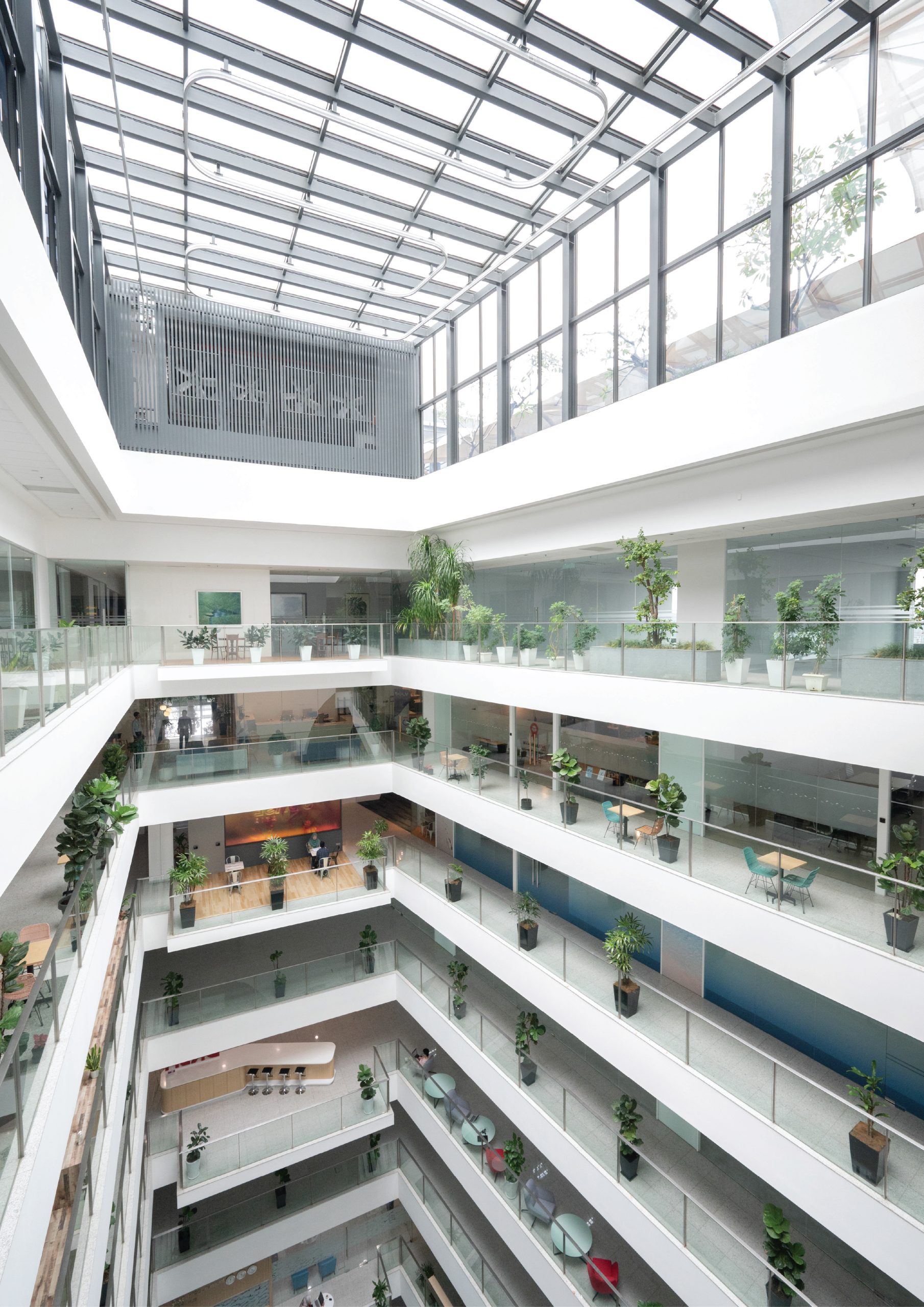
Just as important is the human dimension. A green office building should support occupant well-being through indoor air quality, access to daylight, thermal comfort, acoustic performance, and thoughtful spatial planning. Green design is not only about environmental metrics. It is also about creating a workplace people can function well in, and want to return to.
The Difference Between Green Features and Green Performance
Many office buildings include isolated sustainable features. Fewer operate as genuinely green assets.
This distinction matters. A building may have energy-saving bulbs, some planting, or recycling bins, but those additions alone do not make it a green office building. The stronger standard is performance-based. How efficiently does the building run? How much energy and water does it use relative to comparable assets? Does it deliver measurable comfort for occupants? Is sustainability embedded in design intent and operational management, or applied later as a marketing layer?
The most credible green office buildings are the result of early coordination between architects, engineers, developers, and facilities managers. When sustainability is considered from the beginning, systems work together more intelligently. Facade design can reduce heat gain. Mechanical systems can be right-sized. Shared areas can use daylight more effectively. Over time, that integrated approach tends to deliver better outcomes than piecemeal upgrades.
Why a Green Office Building Matters to Tenants
For office tenants, especially those with established brand standards and environmental targets, the building itself has become part of corporate positioning. Occupying green premises can support ESG reporting, reinforce responsible business practices, and improve staff experience in ways that are commercially meaningful.
A well-executed green office building may help reduce operating costs through lower utility consumption, but cost is only one part of the decision. Workplace quality affects employee comfort, retention, and productivity. Better ventilation, natural light, and more stable indoor temperatures can improve the day-to-day experience in ways that are subtle yet significant.
There is also the reputational aspect. Clients, partners, and employees notice where a company chooses to locate itself. A thoughtfully designed, sustainably operated office often communicates discipline, credibility, and contemporary leadership more effectively than a generic address with a higher fit-out budget.
That said, tenant priorities vary. A professional services firm may emphasize prestige and wellness. A multinational occupier may focus on sustainability benchmarks and reporting requirements. A growing business may care most about balancing quality with occupancy cost. The best green office buildings tend to satisfy more than one of these priorities at once.
Why It Matters to Owners and Investors
From an ownership perspective, green office buildings are often discussed in the language of responsibility, but they are equally relevant in the language of asset strategy.
Buildings that consume less energy and water may offer lower operating costs and stronger management efficiency. Buildings that provide healthier, better-designed workplaces may appeal to more discerning tenants. Buildings that align with evolving regulations, certification frameworks, and occupier expectations may face less risk of becoming outdated.
This does not mean every green office building automatically commands a premium or guarantees stronger returns. Market conditions, location, tenant covenant, specification quality, and management standards still determine performance. But sustainability has become part of how quality is judged. In many segments of the office market, it is increasingly difficult to position an asset as best-in-class without credible green credentials.
For long-term holders, this is especially relevant. The question is not only what the building achieves on day one, but how well it remains competitive over ten or twenty years. Properties designed with resilience, efficient systems, and durable materials often have a stronger foundation for long-term relevance.
Core Elements of a Green Office Building
When people ask what is a green office building, they are often looking for visible proof. Some of that proof is visible, but much of it sits behind the walls and above the ceiling.
A green office building typically brings together energy-conscious design, efficient building systems, water management, and healthy interior environments. It may include high-performance glazing, smart metering, occupancy sensors, efficient lifts, shaded facades, and landscape planning that reduces heat absorption. It may also incorporate bicycle facilities, EV charging, and access to public transit, all of which support lower-impact commuting.
Operations are just as important as design. Even an efficiently designed building can underperform if maintenance is inconsistent or systems are poorly calibrated. Strong building management, regular monitoring, and informed facilities teams are essential to keeping performance aligned with design intent.
Certification can also provide useful external validation. Depending on the market, green office buildings may be assessed under recognized rating systems that evaluate energy use, water efficiency, indoor environmental quality, site planning, and materials. Certification does not replace actual performance, but it can help establish credibility and comparability.
The Trade-Offs Behind Green Development
Green buildings are not defined by ideals alone. They are shaped by decisions, constraints, and trade-offs.
Upfront capital costs can be higher, particularly when better facades, more efficient systems, or advanced controls are introduced early in development. Some features deliver fast payback, while others make more sense over a longer holding period. This is one reason green development tends to align well with owners who think beyond short-term disposal.
There is also the question of balance. A highly technical system may improve efficiency, but if it is difficult to operate or maintain, performance can suffer. A dramatic glazed facade may look impressive, but if it increases heat gain, the sustainability case weakens unless the broader design compensates for it. Good green design is not about adding more. It is about making better coordinated choices.
Occupant behavior also affects results. Buildings can be designed for efficiency, but wasteful tenant use patterns may reduce the intended benefit. This is why the strongest outcomes often come from a partnership between landlord and tenant, supported by clear operational standards and shared expectations.
A Higher Standard for the Future Workplace
The office market is changing, but not in the simplistic way it is often described. Demand has not disappeared. It has become more selective. Businesses are more deliberate about where they lease, what their workplace says about them, and how well a building supports staff, clients, and long-term operational goals.
In that context, green office buildings represent more than environmental compliance. They represent a higher standard of development – one that recognizes efficiency, wellness, design quality, and asset stewardship as connected rather than separate priorities.
For companies seeking workplace credibility, for investors evaluating long-life assets, and for developers committed to enduring value, the question what is a green office building leads to a broader answer. It is a building designed to perform responsibly, operate intelligently, and remain relevant in a market that increasingly rewards quality with substance.
That is why the most successful green office buildings do not merely look contemporary. They are built to stay valuable, useful, and respected well into the future.
No Comments